A guided, self-paced seven-day program for men
Stop carrying the same unfinished priority into another week.
Turn an important stalled priority into a small, scheduled plan. Short recorded lessons and practical worksheets guide you to choose finishable commitments, make time for them, and track what you actually complete.
$79 one-time · Self-paced online · Lifetime access
Start My Seven-Day Sprint — $79Plan about an hour for setup, then 5–15 minutes for daily guidance and check-ins, plus time for your chosen actions.
14-day money-back guarantee. No completion evidence required.
An introduction from Phillip
Start with the reason behind the Sprint.
Watch the introduction, then explore the example below to see how a commitment becomes a plan for your week.
Prefer to read? The example, program details, and price are all below.
Start with something that matters
What keeps making next week’s list?
The project
You keep thinking about it, but “make progress” still has no clear finish line.
The conversation
You know you need to prepare and schedule it. Another week passes without a time.
The decision
You keep gathering information instead of completing the next step you can control.
Bring one meaningful priority into the Sprint. You’ll work out what is small enough to finish, important enough to matter, and realistic for the week you actually have.
See how a Sprint takes shape
A clear commitment. A time. A finish line.
A calendar can hold an appointment. R3 Sprint guides the decisions that come before it: what counts as progress, how small to make the action, and how to keep the plan contained when the week gets uncomfortable.
Illustrative example — not a customer result.
“Make progress on the proposal I keep avoiding.”
Include the problem, proposed approach, and next step. A saved draft is the finish line.
Reserve one specific session for that draft. This example uses one commitment and one execution.
Record the answer. At the final review, examine what helped or interfered before choosing the next Sprint.
Once the Sprint is locked, you follow its rules instead of continually adding, replacing, or expanding goals. The recorded guidance covers friction, substitution, the motivation dip, and the temptation to take on more.
The materials you will use
Less guessing about what to do next.
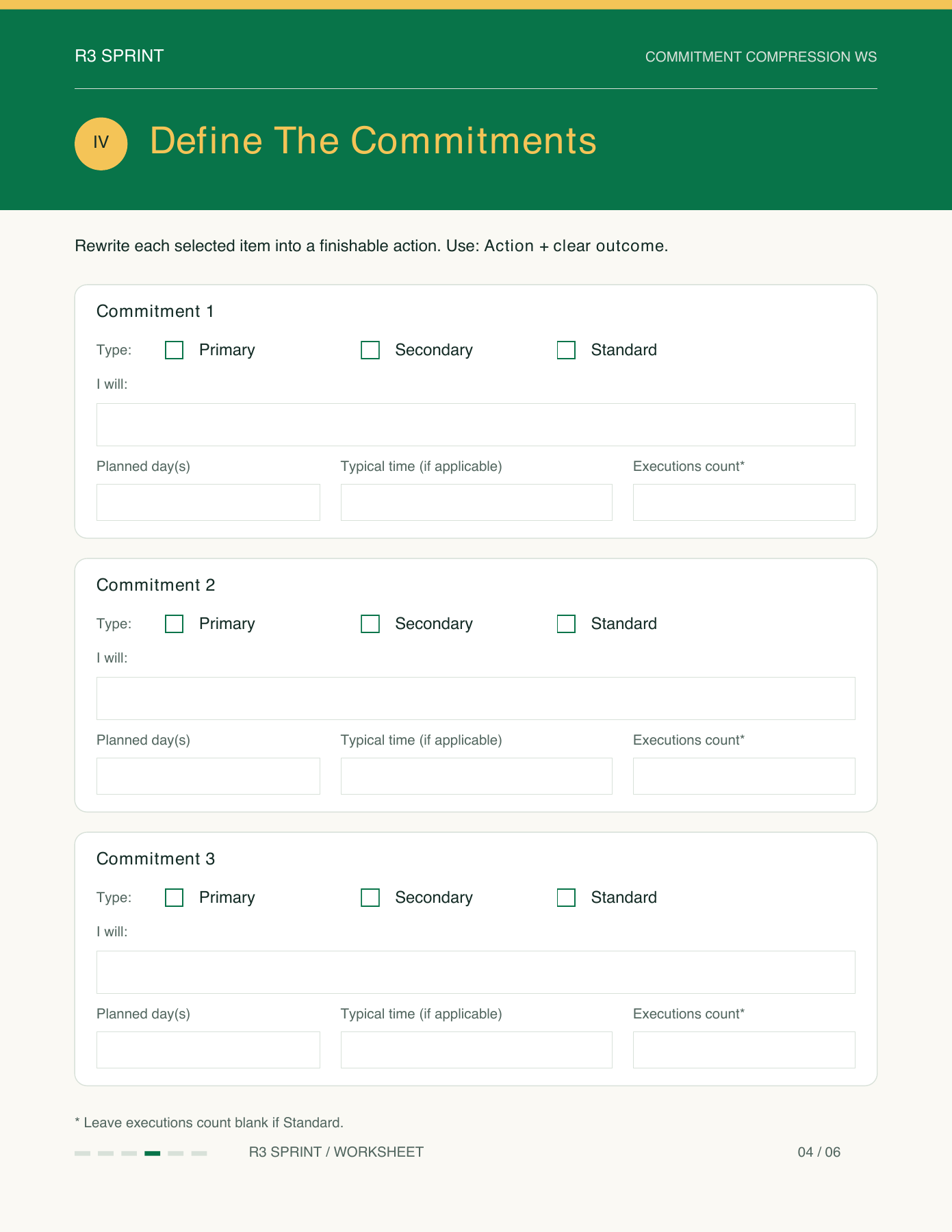
Commitment Compression WS
Choose what will count as meaningful progress. Check that the action breaks inertia, has a clear finish, and fits your week.
“Use: Action + clear outcome”
Excerpt from the actual Commitment Compression WS.
Execution WS
Give each action a specific day and time. Check the whole week before you lock the plan.
Short recorded daily guidance
Work through the predictable obstacles to following your plan, including friction, substitution, and fading motivation.
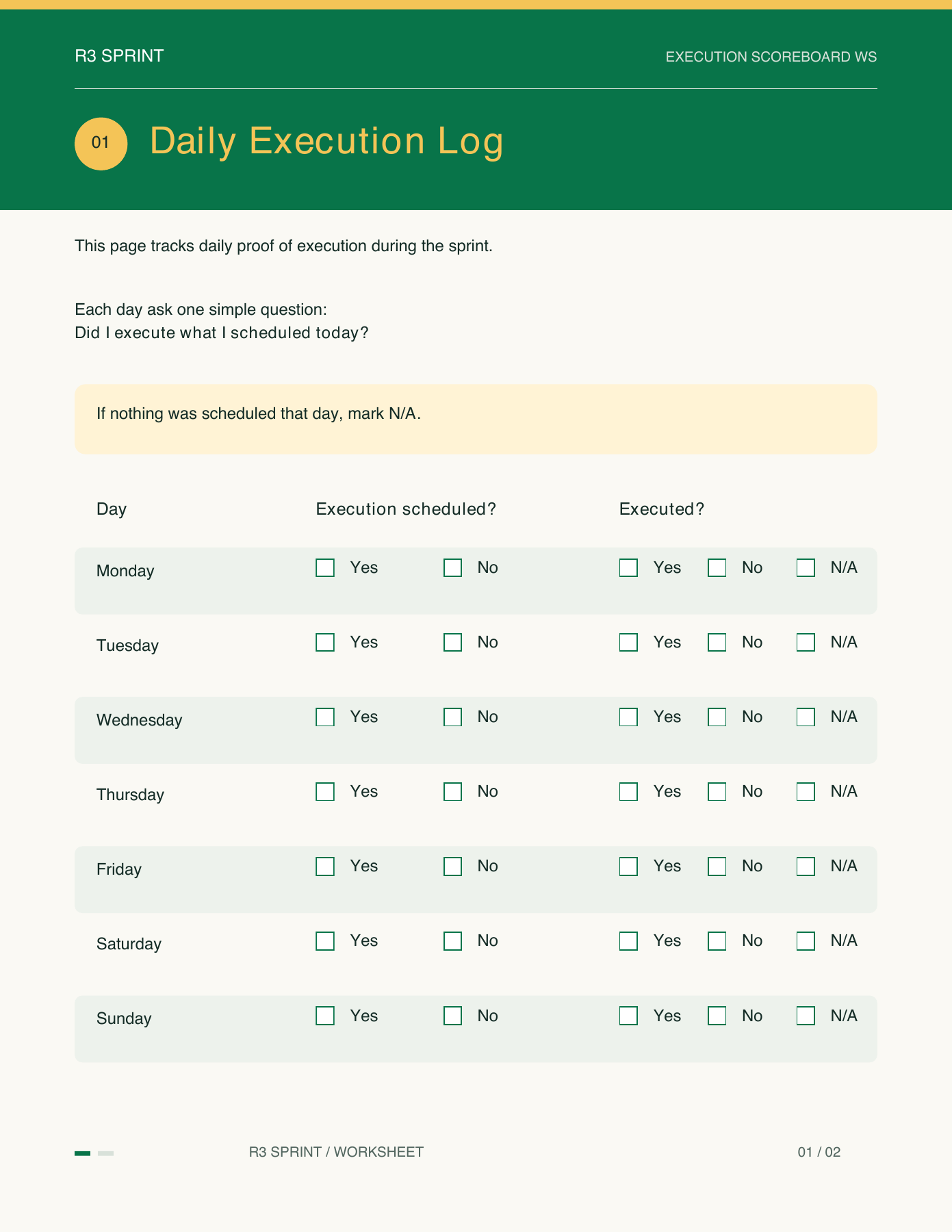
Execution Scoreboard WS
Record whether you did what was scheduled. Mark N/A when no execution was scheduled that day.
“Did I execute what I scheduled today?”
Excerpt from the actual Execution Scoreboard WS.
Sprint rules
Keep the commitments and execution windows contained. Use the rules when you are tempted to renegotiate the plan midweek.
The Final Review WS
Look at completion, scope, avoidance, and scheduling. Use the record to decide what to repeat or adjust in a future Sprint.
Your week at a glance
Set up. Run your seven days. Review.
A clear sequence, from your first commitment to your final review.
Set up your Sprint
ABOUT AN HOUR
- Watch the setup lessons
- Choose 1–3 commitments
- Schedule up to 7 executions
Run your seven days
DAYS 1–7
- Use the short daily guidance
- Carry out scheduled actions
- Record what happened
Review your week
ABOUT 10–15 MINUTES
- Complete your final review
- Decide what to repeat or adjust
During the week, allow 5–15 minutes for daily guidance and check-ins, plus time for your chosen actions. Self-paced means you choose when to begin. Individual coaching and live accountability are not included.

Meet your instructor
Phillip Treiber
LMHC · MCAP · NCC
I created R3 Sprint around a practical constraint: choose a small enough plan to use in your actual week, then look honestly at what happened.
R3 Sprint is an educational, self-paced program. Purchasing it does not establish a therapy relationship or include individualized mental health treatment.
Choose it with clear expectations
You can be inconsistent and still begin.
A fit if you’re willing to…
- Bring an important priority you keep postponing.
- Choose a smaller, finishable plan for one week.
- Reserve time and use the tools, even if follow-through has been difficult.
- Record what happened honestly.
Know what you’re buying.
You receive a guided process you put into practice. It requires time for your chosen actions.
It does not include live coaching, personal accountability contact, or therapy. A week of practice is not a promise to permanently change your habits or solve every underlying problem.
Miss an execution? Record it and continue.
Mark the miss honestly. Don’t replace it with another task, add a makeup session, or restart the whole Sprint. Continue with the next scheduled execution and examine the miss in your final review.
R3 Sprint
Give one important priority a defined week.
Short recorded lessons, commitment and scheduling tools, a daily scoreboard, Sprint rules, and a final review.
One-time payment · Lifetime access
Self-paced online program
14-day money-back guarantee
Try R3 Sprint. If you decide it is not right for you, email onlinecourse@dudebreathecounseling.com within 14 days of purchase for a full refund.
No worksheets or proof of completion required.
Course access ends after your refund is processed.
The Sprint runs for seven days. Your refund window starts on the purchase date.
Before you begin
A few practical questions.
How is this different from writing a to-do list?
The worksheets help you choose meaningful, finishable commitments, test their scope, and lock specific execution windows. The daily guidance addresses common ways a plan gets expanded or avoided. The final review turns the week’s record into decisions for the next attempt.
Do I have to choose three commitments?
No. Three commitments and seven executions are upper limits, not quotas. At least one primary commitment must break inertia on something meaningful. The course guides you to a plan that fits your actual capacity.
How much time will I need?
Plan about an hour for setup, then 5–15 minutes for daily guidance and check-ins, plus time to carry out your chosen actions. Allow about 10–15 minutes for the final review. The size of your commitments determines the execution time.
What happens after I buy?
You receive online course access and instructions to sign in. The lessons and worksheets are self-paced, so you can choose when to start. For access questions, email onlinecourse@dudebreathecounseling.com.
Is this coaching or therapy?
No. It is a self-paced educational program with recorded guidance and worksheets. It does not include live sessions, individual coaching, personal accountability contact, or mental health treatment.
Can I use the tools again?
Yes. Your one-time purchase includes lifetime access. Use the final review to decide what to carry into a later Sprint.
How do I request a refund?
Email onlinecourse@dudebreathecounseling.com within 14 days of purchase for a full refund. No worksheets or proof of completion are required. Course access ends after the refund is processed.